Introducing Meddy One: AI that helps explain the value of medical innovations
We are rolling out Meddy One to a first select group of users. Our context-aware AI helps users understand the results of health-economic applications—and the inputs, assumptions and clinical pathways behind them.
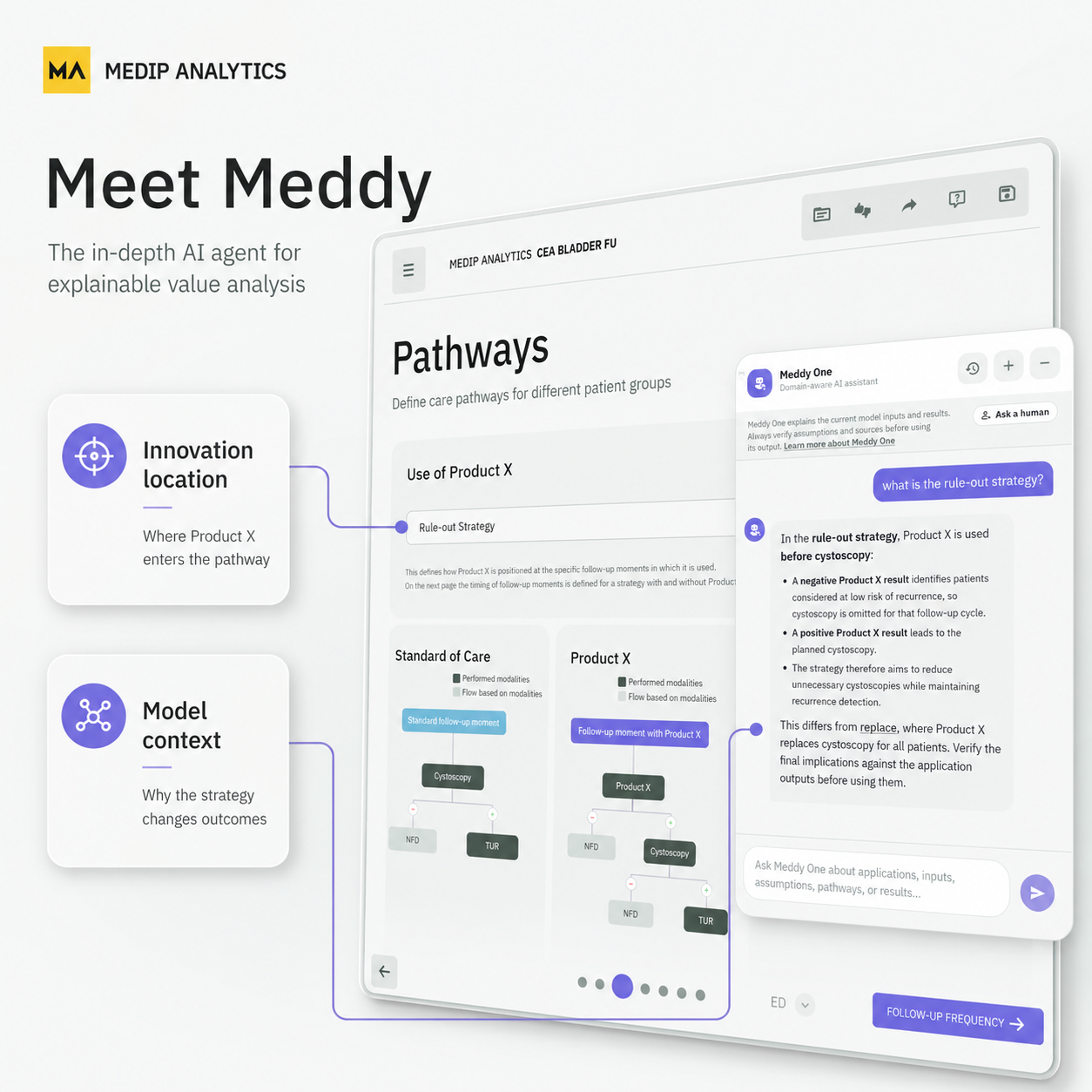
Why does an innovation create more value in one healthcare setting than another? Why do healthcare costs increase while patient outcomes improve? And what changes when a different patient population or clinical pathway is considered?
Health-economic models help answer these questions. Yet their complexity can make the answers difficult to interpret, particularly for people who did not build the model. A result may be clear on screen while the reasons behind it remain a mystery.
At Medip Analytics, we believe health-economic software should do more than calculate outcomes. It should help people understand how those outcomes arise. That belief is behind Meddy One, our context-aware AI assistant, and our focus on making health-economic analysis more explainable.
Opening the black box
The value of a medical innovation depends on its context: the patients, the care pathway, available capacity and the assumptions used in the analysis. These factors interact, influencing costs, health outcomes and wider impacts.
Understanding those relationships is essential to interpreting results. A diagnostic test, for example, may add costs at the beginning of a pathway while reducing unnecessary procedures later. Whether that translates into overall savings depends on how often those procedures are avoided and their costs in the selected setting.
Our focus on explainable AI is about making this model logic easier to follow. We want users to understand what connects an input to an outcome, which assumptions help explain a result, and where uncertainty matters.
From results to understanding
Meddy One is built to help users navigate this complexity through questions in everyday language. Grounded in the application’s context, it helps explain inputs, assumptions, disease pathways and results.
A user might ask: “Why are costs higher in this scenario?”, “How does the patient population affect these outcomes?” or “Why does this innovation improve health outcomes without reducing expenditure?”
The aim is to connect the answer to the underlying model: how a change affects the clinical pathway, how that pathway affects resource use and patient outcomes, and how those effects contribute to the final results.
This also creates opportunities to explore further. Meddy One can help users formulate relevant scenarios to investigate—for example, considering a different patient population or changing an assumption about treatment uptake. Running those scenarios in the application allows teams to examine how the results change.
Making value discussions more useful
For teams working in market access, medical affairs and evidence generation, understanding a result is essential to communicating it. Explaining the relationships behind an outcome helps teams discuss evidence with colleagues, healthcare professionals and payers, and identify questions that need further investigation.
That includes challenging findings. A scenario in which an innovation is not cost-effective can be as informative as one in which it is. Understanding why helps clarify the conditions under which an innovation may create value.
AI adds value when it makes these discussions more accessible while keeping evidence and assumptions visible. The model remains the basis of the analysis; Meddy One helps users explore and interpret it.
A next step for the Medip Platform
We are rolling out Meddy One to a first select group of users, taking the next step in our vision for more explainable, collaborative and locally relevant value analysis.
As we shared in our founder story, health-economic analyses should be dynamic, transparent and understandable. Meddy One builds on that ambition: helping more people ask meaningful questions, understand the answers and discuss what they mean for their healthcare setting.